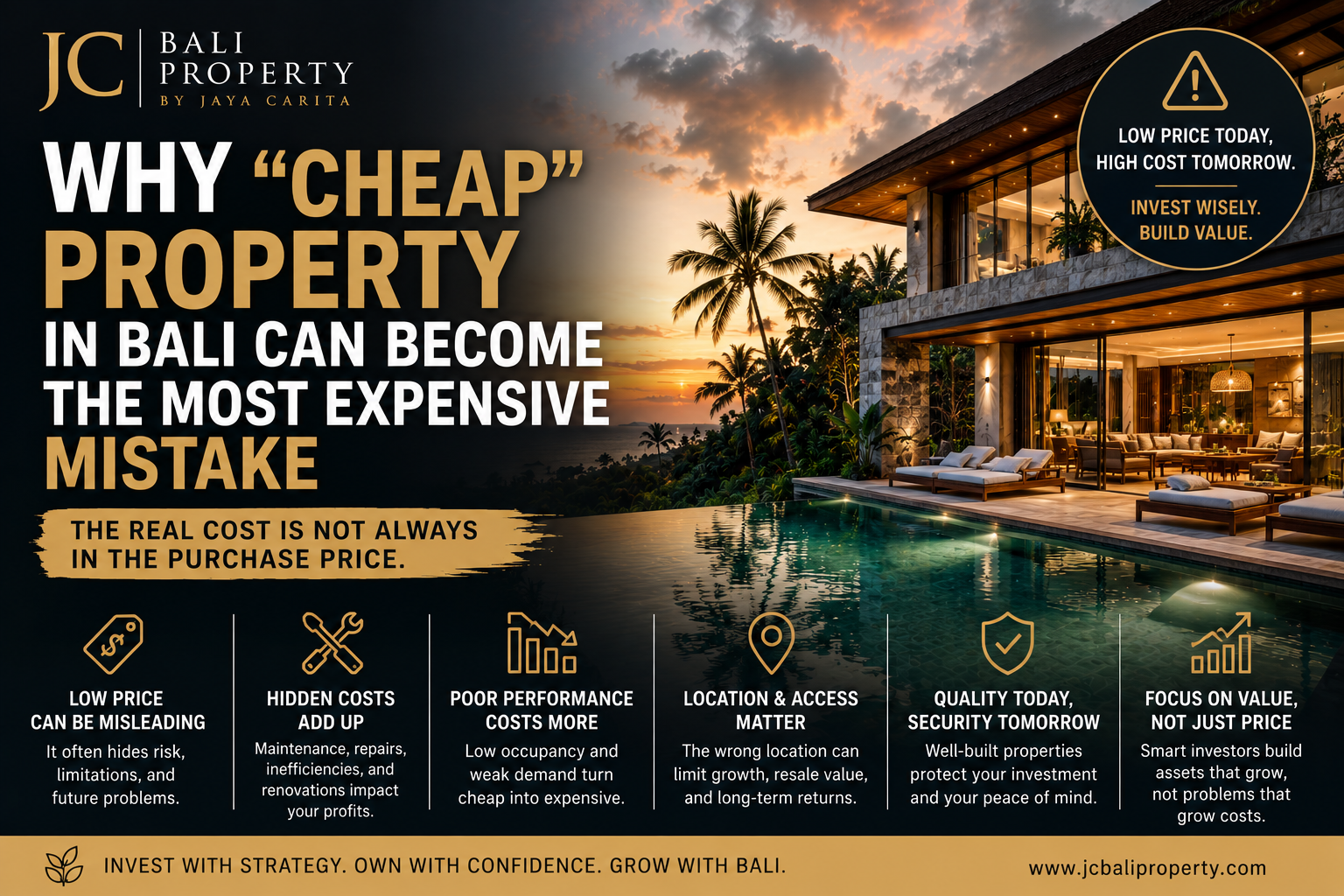
Why “Cheap” Property in Bali Can Become the Most Expensive Mistake
Because the real cost of property is not always in the purchase price.
In Bali’s fast-growing property market, attractive deals appear everywhere.
Cheap land.
Affordable villas.
“Limited-time opportunities.”
“Below market price.”
At first glance, these offers seem exciting.
Especially for first-time investors.
The logic feels simple:
If the entry price is lower, the investment must be better.
But in reality, property does not work that way.
Because one of the most dangerous assumptions in real estate is believing that:
Cheap automatically means profitable.
And in Bali, this misunderstanding often leads to expensive long-term consequences.
The Psychology Behind Cheap Deals
Humans naturally feel attracted to discounts.
Whether in:
- Retail
- Travel
- Real estate
Lower prices create emotional urgency.
People fear:
- Missing opportunities
- Paying too much later
- Losing access to “good deals”
This emotional reaction often pushes buyers to focus heavily on:
Price.
Instead of:
Value.
And this is where problems begin.
Why Low Prices Can Be Misleading
A low property price is not automatically a good investment.
Because pricing in real estate usually reflects:
- Demand
- Accessibility
- Market confidence
- Future potential
- Risk factors
If something is significantly cheaper than surrounding properties, there is usually a reason.
The challenge is:
Many investors only see the number.
Not the context behind it.
The Hidden Costs Nobody Talks About
When people calculate property investment, they often focus only on:
- Purchase price
- Construction budget
But real ownership involves much more.
There are hidden costs such as:
- Maintenance
- Renovation
- Operational inefficiencies
- Poor occupancy
- Weak resale value
A cheap property that performs poorly may become far more expensive over time than a higher-quality asset with stronger performance.
Cheap Entry Does Not Guarantee Strong Returns
One of the most common misconceptions:
“Lower investment means higher ROI.”
But ROI depends on:
Performance.
A cheaper villa that struggles with:
- Bookings
- Reviews
- Visibility
May generate weaker returns overall.
Meanwhile, a stronger property with better positioning may outperform consistently for years.
This is why professional investors focus less on:
Cheapness.
And more on:
Long-term value creation.
Location Still Matters—But Not the Way People Think
Many cheap properties are located in areas that appear “up-and-coming.”
And while emerging locations can create opportunities, there is also risk.
Important questions include:
- Is infrastructure improving?
- Is demand actually growing?
- Is accessibility realistic?
- Is oversupply becoming a problem?
Some areas develop rapidly.
Others stagnate for years.
The difference matters.
The Problem With Buying Based on Fear
Many rushed investment decisions are emotionally driven by fear.
Fear of:
- Missing out
- Rising prices
- Lost opportunity
This creates impulsive behavior.
And impulsive decisions often ignore:
- Due diligence
- Long-term strategy
- Market understanding
Strong investments rarely come from panic.
They come from clarity.
Not Every Villa Is Designed to Perform
Some properties are built primarily to:
Sell quickly.
Not necessarily to:
Operate successfully long term.
This creates issues such as:
- Poor layouts
- Weak functionality
- Operational inefficiency
- Maintenance challenges
At first glance, these properties may still look attractive online.
But operational weaknesses appear over time.
And operational problems reduce:
Guest satisfaction and profitability.
The Difference Between Cost and Value
Cost is what you pay.
Value is what you receive over time.
This distinction is critical in Bali property.
A property may cost less initially but create:
- Stress
- Lower returns
- Operational issues
- Limited resale demand
Another property may require higher entry capital but generate:
- Stronger occupancy
- Better reviews
- Better appreciation
- Easier management
True value extends beyond the purchase moment.
Why Experienced Investors Focus on Sustainability
Experienced investors often ask:
“Can this property continue performing five years from now?”
Not just:
“Can I buy this cheaply today?”
This long-term perspective changes everything.
Because sustainable performance creates:
- Stability
- Predictable income
- Stronger asset value
Short-term excitement fades quickly.
Long-term fundamentals matter more.
The Operational Reality of Bali Villas
Owning property in Bali involves ongoing operations.
This includes:
- Staff management
- Maintenance
- Guest communication
- Platform optimization
- Repairs and upkeep
Poorly built or poorly designed properties often create:
Higher operational friction.
Which means:
The “cheap” property slowly becomes more expensive over time.
Cheap Properties Often Compete Mainly on Price
Another hidden problem:
Many low-cost villas struggle to differentiate themselves.
Without strong positioning, they often compete mainly through:
Discount pricing.
This creates:
- Lower margins
- More booking pressure
- Reduced long-term profitability
Strong properties compete through:
Experience and value perception.
Not constant discounting.
Why Branding Matters More Than Ever
Modern Bali property is no longer only about buildings.
It’s also about:
- Perception
- Identity
- Emotional appeal
Properties with stronger branding often achieve:
- Better occupancy
- Higher pricing flexibility
- More loyal guests
Even when competitors are cheaper.
Because people do not always choose the cheapest option.
They choose the option that feels most valuable.
The Airbnb Effect Changed Guest Expectations
Platforms like Airbnb transformed hospitality standards globally.
Guests now compare:
- Hundreds of listings instantly
- Reviews
- Experiences
- Visual presentation
This creates intense competition.
And in competitive markets, generic properties struggle more.
Why Patience Creates Better Decisions
One of the strongest advantages in investing:
Patience.
Rushed decisions often overlook:
- Structural issues
- Market weaknesses
- Long-term viability
Careful analysis creates:
Better positioning and lower regret.
The best investors are rarely the fastest.
They are often the most disciplined.
The Illusion of “Easy Passive Income”
Cheap property advertisements often promote:
“Easy passive income.”
But property performance is never automatic.
Successful villas require:
- Strong systems
- Market understanding
- Continuous optimization
Without these, even low-cost properties become difficult to sustain.
What Smart Investors Prioritize Instead
Rather than chasing the cheapest opportunity, experienced investors focus on:
- Market fit
- Operational sustainability
- Long-term demand
- Experience quality
- Brand positioning
Because these factors influence performance far more than:
Entry price alone.
Bali Is Still Full of Opportunity—But Strategy Matters
This does not mean cheap properties are always bad.
Some can become excellent investments.
But success depends on:
- Research
- Positioning
- Timing
- Understanding the local market
The key difference is:
Strategic evaluation.
Not emotional reaction.
The Bigger Picture
Property investment is not about:
Finding the cheapest asset.
It’s about:
Finding the strongest long-term opportunity.
And those are not always the same thing.
Final Thought
In Bali property, cheap prices can sometimes hide expensive problems.
Because the true cost of a property is not only what you pay today.
It’s:
- What the property demands over time
- How well it performs
- How sustainable it becomes
The strongest investments are rarely built on excitement alone.
They are built on:
Clarity, patience, and strategy.
Looking for Smarter Bali Property Opportunities?
If you want to approach Bali property with:
- Better strategy
- Clearer market understanding
- Long-term investment thinking
We can help you evaluate opportunities beyond just price—toward sustainable value.