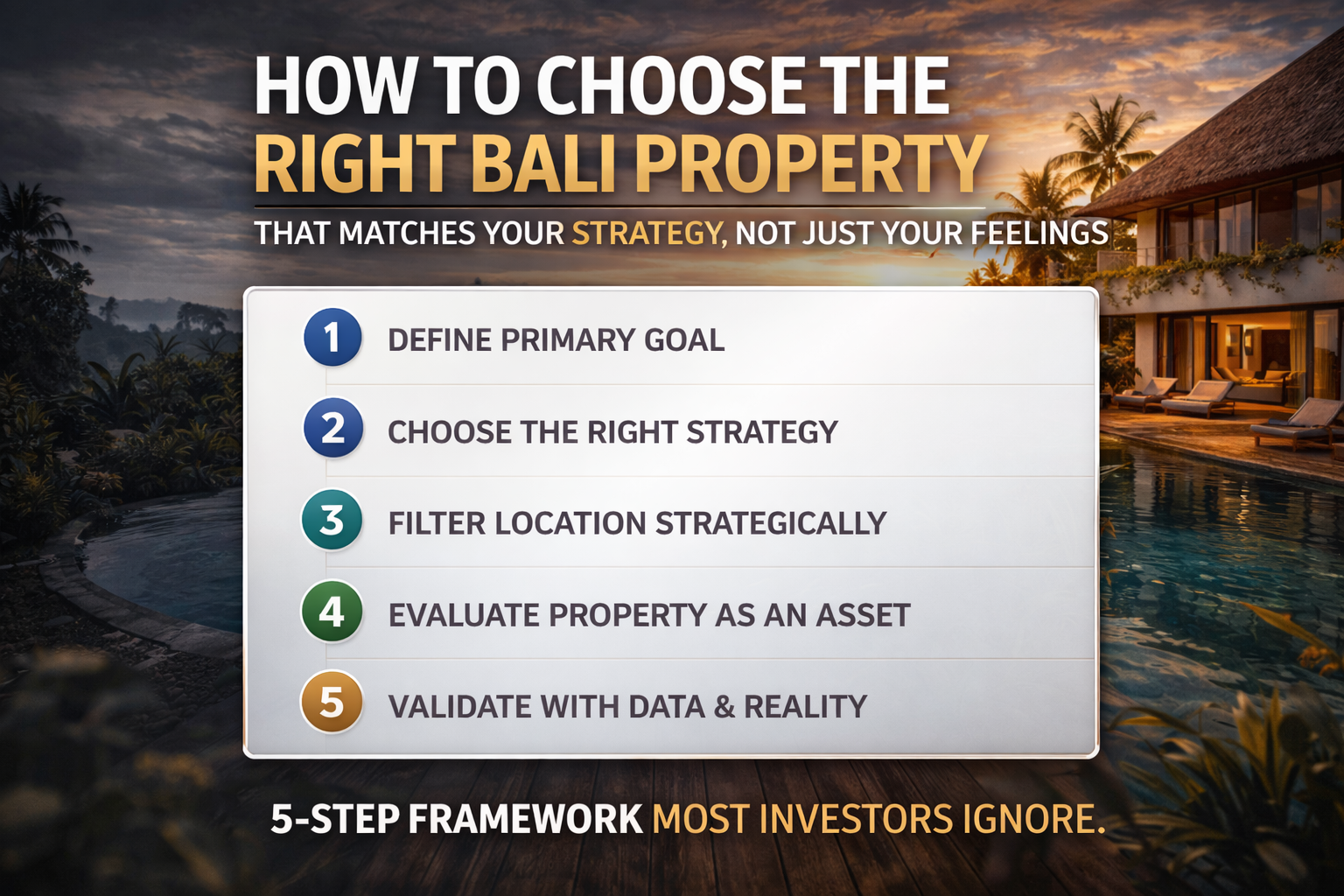
How to Choose the Right Bali Property (A Simple Framework Most Investors Don’t Use)
Because the difference between a good deal and a great investment is clarity.
Choosing a property in Bali sounds simple.
You browse listings.
You visit villas.
You compare prices.
And eventually—you decide.
But in reality, this is where most investors go wrong.
Not because they don’t try.
But because they don’t have a clear framework.
They rely on:
- Feeling
- Opinions
- Random comparisons
Instead of a structured decision-making process.
And in a market like Bali, that can make a big difference.
The Problem: Too Many Options, No Clear Direction
Bali offers a wide range of properties:
- Different areas
- Different price levels
- Different styles
- Different strategies
At first, this feels like an advantage.
But quickly, it becomes overwhelming.
You start asking:
- “Is this a good deal?”
- “What if there’s something better?”
- “Am I choosing the right one?”
Without a framework, every option feels uncertain.
The Solution: A 5-Step Decision Framework
Instead of guessing, smart investors use structure.
Here’s a simple framework you can follow.
Step 1: Define Your Primary Goal
Everything starts here.
Before looking at any property, ask:
“What is my main objective?”
Is it:
- Monthly passive income?
- High short-term returns?
- Long-term appreciation?
- Lifestyle + investment?
This decision filters everything.
Because not every property fits every goal.
Step 2: Choose the Right Strategy
Once your goal is clear, define your strategy.
For example:
- Daily rental (Airbnb model)
- Monthly rental
- Yearly lease
- Hybrid model
Each strategy impacts:
- Location
- Design
- Pricing
- Management
Choosing a property without strategy is like:
Driving without direction.
Step 3: Filter by Location (Strategically, Not Emotionally)
Now you choose the area.
But not based on hype.
Based on fit.
Ask:
- Does this location match my strategy?
- Is demand strong for my target market?
- Is the area growing or already saturated?
This step eliminates many poor choices early.
Step 4: Evaluate the Property as an Asset
This is where most people get emotional.
They think:
“I like this villa.”
But instead, ask:
“Will this villa perform?”
Evaluate:
- Access & location details
- Layout functionality
- Build quality
- Market demand fit
A good-looking villa is not always a good investment.
Step 5: Validate With Data & Reality
Before deciding, validate everything:
- Rental potential
- Market comparison
- Realistic pricing
- Operating costs
This step turns:
Assumptions → into informed decisions.
Why Most Investors Skip This Process
Because it requires effort.
It’s easier to:
- Follow trends
- Trust opinions
- Decide based on feeling
But easy decisions often lead to:
Average results.
What Happens When You Use a Framework
Everything becomes clearer.
Instead of:
“I’m not sure…”
You start thinking:
“This fits my strategy.”
Instead of:
“Maybe this is good…”
You know:
“This makes sense.”
Clarity reduces stress.
And improves decisions.
The Hidden Benefit: Confidence
Most investors are not lacking opportunity.
They are lacking confidence.
And confidence doesn’t come from guessing.
It comes from:
- Structure
- Understanding
- Process
Common Mistakes Without a Framework
Without structure, people often:
- Choose based on emotion
- Overpay for the wrong property
- Misjudge rental potential
- Ignore key risks
And these mistakes are costly.
The Truth About “The Perfect Property”
There is no perfect property.
Only:
- Well-matched properties
- Poorly matched properties
The goal is not perfection.
It’s alignment.
Final Thought
Choosing property in Bali is not about finding the best villa.
It’s about finding the right villa for your strategy.
And the difference comes down to one thing:
Having a clear framework.
Looking for a Structured Approach?
If you want to:
- Avoid confusion
- Make confident decisions
- Choose properties that actually perform
We can guide you through a clear, step-by-step process.