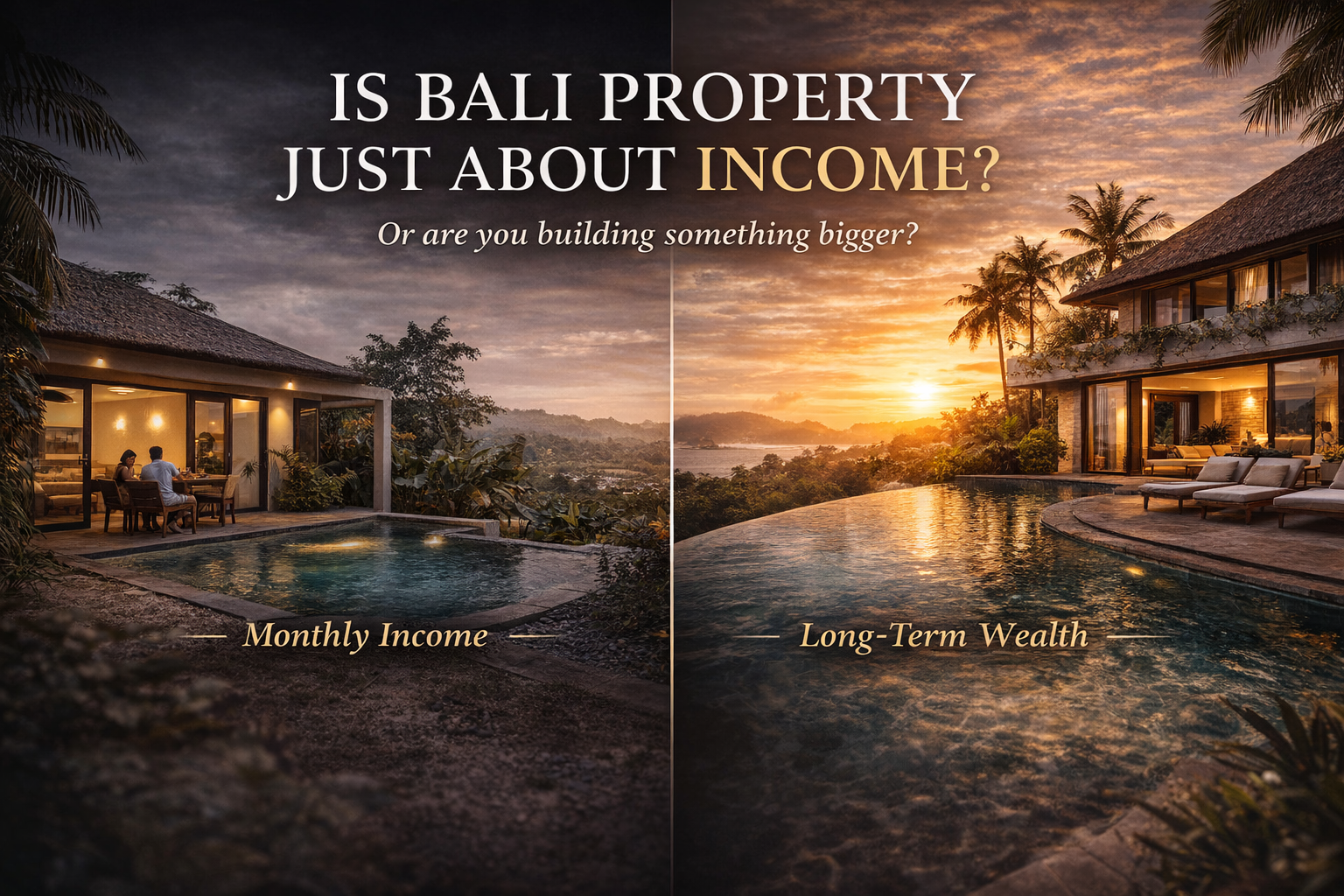
Is Bali Property Just About Rental Income? Or Something Bigger?
Understanding the long-term wealth game most investors overlook
When people first consider investing in Bali property, the conversation almost always starts with numbers.
“How much can I earn per month?”
“What’s the ROI?”
“How fast can I get my capital back?”
These are valid questions.
In fact, they are necessary.
But they are also incomplete.
Because if you only evaluate a property based on its monthly income, you are looking at just one layer of a much larger opportunity.
And in many cases, focusing only on income can lead to decisions that limit long-term potential.
To understand Bali property properly, you need to shift perspective.
From income…
To wealth creation.
The Two Mindsets: Income vs Wealth
At the core of every investment decision is a mindset.
And in property, there are two dominant ones.
1. The Income Mindset
This is where most people start.
It focuses on:
- Monthly rental income
- Occupancy rates
- Return on investment (ROI)
- Payback period
This mindset is practical and straightforward.
It answers immediate questions.
But it also has limitations.
Because it tends to prioritize:
- Short-term performance
- Quick returns
- Simplified calculations
As a result, it may overlook factors that matter more over time.
2. The Wealth Mindset
More experienced investors think differently.
They focus on:
- Asset appreciation
- Market positioning
- Long-term demand
- Exit potential
They understand that:
A property is not just a source of income.
It is a strategic asset.
And the value of that asset evolves over time.
Why Rental Income Alone Can Be Misleading
Rental income is often presented as the main attraction.
And yes, Bali can generate strong rental returns.
But there are realities that must be understood.
Income is:
- Variable
- Dependent on management
- Influenced by seasonality
- Affected by competition
A villa that performs well today may not perform the same way in 3–5 years.
New properties enter the market.
Trends shift.
Guest expectations evolve.
So while income is important…
It should not be the only factor guiding your decision.
Understanding Capital Appreciation
This is where the bigger picture begins.
Capital appreciation refers to the increase in property value over time.
And in Bali, this can be significant—especially in developing areas.
Why does appreciation happen?
Because of:
- Infrastructure development
- Increased demand
- Area popularity
- Limited land availability in key locations
Investors who enter early in the right areas often benefit the most.
And in some cases, appreciation alone can represent a large portion of total returns.
The Power of Entering at the Right Stage
Timing in property is not about guessing the market.
It’s about understanding where the market is in its cycle.
In emerging areas:
- Prices are lower
- Risk is higher
- Growth potential is strong
In established areas:
- Prices are higher
- Risk is lower
- Growth is more stable
Neither is inherently better.
They simply serve different strategies.
But what matters is alignment.
Choosing the right stage based on your goals.
Location Is Not Just About Today
When selecting a property, many investors focus on current popularity.
They ask:
“Is this area trending?”
But a better question is:
“Where is this area going?”
Because wealth is built by positioning yourself ahead of growth.
Not after it happens.
Understanding this requires:
- Local insight
- Market awareness
- Long-term perspective
Time: The Most Underrated Factor
Property is not a short-term game.
It rewards patience.
Over time:
- Markets grow
- Demand stabilizes
- Value compounds
Holding a property allows:
- Appreciation to accumulate
- Income to stabilize
- Flexibility to increase
Short-term thinking limits this potential.
Long-term thinking unlocks it.
The Role of Strategy in Wealth Creation
Not all properties create wealth equally.
The difference lies in strategy.
A strong strategy considers:
- Entry price
- Location potential
- Property positioning
- Management quality
- Exit options
Without strategy, a property becomes:
Just a purchase.
With strategy, it becomes:
An asset.
Lifestyle as Part of the Return
Bali offers something unique.
It combines:
- Investment potential
- Lifestyle value
This creates a hybrid model.
Where investors:
- Generate income
- Enjoy personal use
- Build long-term value
For many, this adds a dimension that pure financial investments cannot provide.
Exit Strategy: Where Wealth Becomes Real
One of the most overlooked aspects of investing is the exit.
Many people focus on:
Buying.
Few think about:
Selling.
But wealth is often realized at the point of exit.
This can include:
- Selling at a higher value
- Transferring a lease
- Repositioning the asset
Without a clear exit strategy, you limit your ability to capture full value.
The Compounding Effect of Good Decisions
One successful investment does more than generate returns.
It creates:
- Experience
- Confidence
- Network
These lead to:
Better future decisions.
And over time, this compounds.
This is how portfolios are built.
Not through one perfect deal.
But through a series of well-executed decisions.
Why Most Investors Miss the Bigger Picture
Because focusing on income feels easier.
It’s measurable.
It’s immediate.
It’s clear.
But wealth is built differently.
It requires:
- Patience
- Vision
- Strategic thinking
And these are less visible in the short term.
Risk vs Opportunity
Every investment carries risk.
Bali is no different.
Risks include:
- Market changes
- Regulatory considerations
- Management challenges
But risk is not something to avoid entirely.
It is something to understand and manage.
Because within risk lies opportunity.
The Evolution of the Bali Market
Bali is not static.
It is evolving.
As the market matures:
- Competition increases
- Standards rise
- Opportunities shift
This means:
What worked in the past may not work in the future.
Investors who adapt succeed.
Those who rely on outdated assumptions struggle.
Building a Portfolio, Not Just Owning Property
A single villa is a starting point.
But long-term investors think in terms of:
Portfolios.
Multiple properties.
Different strategies.
Diversified risk.
This approach creates:
- Stability
- Flexibility
- Greater growth potential
The Real Question to Ask
Instead of asking:
“How much can I earn?”
Ask:
“What position am I building?”
Because position determines:
- Future options
- Growth potential
- Long-term value
Final Thought
Bali property is not just about rental income.
It is about building something that:
- Generates income
- Grows in value
- Creates opportunity over time
And the difference lies in how you approach it.
Looking Beyond Income?
If you want to:
- Understand long-term strategy
- Identify growth areas
- Build a strong investment position
We can help you approach Bali property with a clearer perspective.