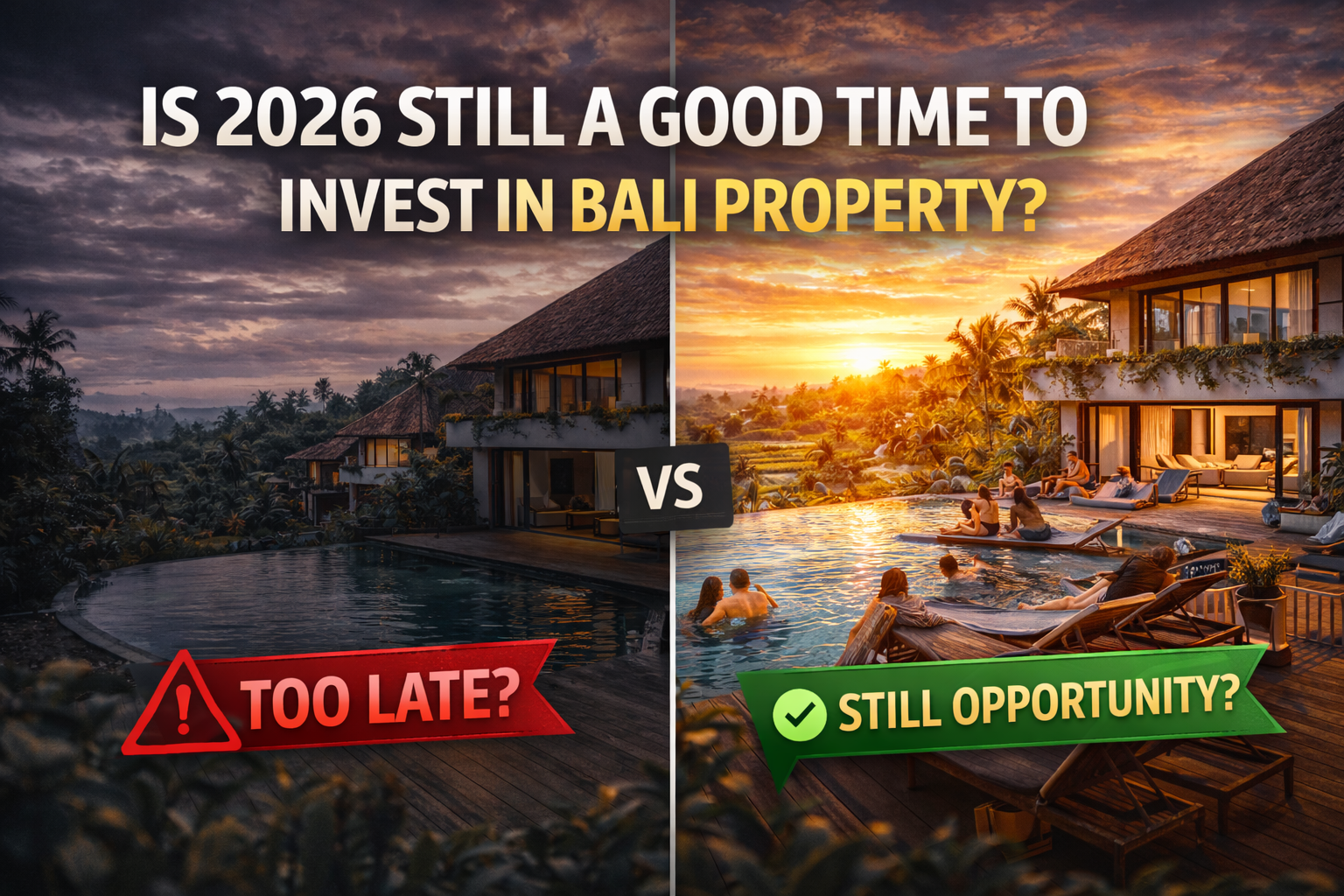
Is 2026 Still a Good Time to Invest in Bali Property? Here’s the Real Answer
Understanding Market Timing, Opportunity Windows, and What Smart Investors Are Doing Differently
Every year, the same question comes up:
“Is it still a good time to invest in Bali property?”
It’s a simple question.
But the answer is not simple.
Because in real estate, timing is not just about the calendar.
It’s about understanding where a market stands—and where it’s going.
And right now, Bali sits in a very unique position.
It’s no longer an undiscovered opportunity.
But it’s not fully saturated either.
It’s in transition.
And for investors, that’s where things get interesting.
Understanding Market Phases: Where Bali Stands Today
Every property market goes through phases:
- Early stage
- Growth phase
- Maturing phase
- Saturation
Each phase offers different types of opportunities.
In the early stage:
- Prices are low
- Risk is high
- Potential upside is large
In the growth phase:
- Demand increases
- Development expands
- Returns become more visible
In the mature phase:
- Competition rises
- Standards increase
- Easy opportunities decrease
So where is Bali today?
Somewhere between growth and maturity.
This is critical to understand.
Because it explains why:
- Opportunities still exist
- But require more precision
The End of “Easy Investing”
A few years ago, investing in Bali felt simple.
Buy a villa.
List it online.
Generate income.
At that time:
- Supply was limited
- Demand was rising
- Competition was low
Almost any decent property could perform.
But markets evolve.
Today:
- More villas are available
- More investors are entering
- More listings compete for attention
This means one thing:
The era of “easy investing” is over.
But that doesn’t mean opportunity is gone.
It means the market has become selective.
Selective Markets Create Smarter Investors
In a less competitive market, average decisions can still succeed.
In a competitive market, only strong decisions perform.
This shift filters the market.
It rewards:
- Strategy
- Knowledge
- Preparation
And it exposes:
- Assumptions
- Poor planning
- Emotional decisions
For serious investors, this is actually a positive development.
Because it reduces noise.
And increases clarity.
Demand Is Still There—But It Has Evolved
One of the biggest concerns people have is:
“Is demand still strong?”
The short answer is:
Yes.
But it’s different.
Bali continues to attract:
- International tourists
- Remote workers
- Long-term residents
However, these audiences are evolving.
They are:
- More experienced
- More selective
- More value-conscious
They don’t just book the first available villa.
They compare.
They evaluate.
They choose.
Which means:
Your property must compete—not just exist.
The Shift from Quantity to Quality
In earlier years, quantity mattered.
Having a villa in a good area was often enough.
Today, quality defines success.
This includes:
- Design
- Functionality
- Comfort
- Experience
- Management
The market is no longer driven by availability.
It is driven by preference.
Guests choose properties that:
- Stand out
- Feel intentional
- Deliver a clear experience
This creates a new standard.
Pricing Is Becoming More Rational
Another important shift:
Pricing is stabilizing.
In less mature markets, pricing is often driven by:
- Optimism
- Speculation
- Unrealistic expectations
As markets mature, pricing becomes:
- More data-driven
- More competitive
- More aligned with performance
For investors, this is beneficial.
Because it reduces the risk of:
- Overpaying
- Overestimating returns
It creates a more balanced environment.
Location Still Matters—But Strategy Matters More
Location has always been important.
But in today’s Bali market, it’s not just about choosing a popular area.
It’s about choosing the right location for your strategy.
For example:
- Short-term rental focus → high-demand lifestyle areas
- Long-term rental focus → quieter, livable environments
- Appreciation focus → emerging zones
Choosing a location without strategy leads to:
- Mismatch with demand
- Lower performance
Smart investors reverse the process:
- Define strategy first
- Then select location
The Role of Emerging Areas
As prime areas become more competitive, attention shifts.
New areas begin to emerge.
These areas offer:
- Lower entry prices
- Development potential
- Future growth
But they also come with:
- Higher uncertainty
- Slower demand growth
This creates a classic investment trade-off:
Stability vs Growth
- Established areas → lower risk, lower upside
- Emerging areas → higher risk, higher upside
Understanding your position on this spectrum is essential.
Why Bali Still Stands Out Globally
Despite market evolution, Bali remains attractive.
Compared to many global markets, it offers:
- Lower entry barriers
- Lifestyle-driven demand
- Flexible rental strategies
In cities like:
- Sydney
- London
- Singapore
Property prices are significantly higher.
And rental yields are often lower.
Bali presents a different equation.
One that combines:
- Lifestyle appeal
- Income potential
This combination is rare.
And it continues to attract international investors.
Risk Awareness Is Increasing
Another sign of market maturity:
Investors are asking better questions.
They are more aware of:
- Legal structures
- Ownership models
- Rental regulations
- Management requirements
This leads to:
- Better decisions
- Fewer mistakes
- More sustainable investments
A market with informed investors is a stronger market.
The Psychology of “Waiting”
Many investors hesitate.
They think:
“Maybe I should wait.”
Wait for:
- Better prices
- More clarity
- Less risk
But waiting has its own cost.
As markets grow:
- Prices increase
- Competition rises
- Opportunities narrow
There is rarely a “perfect time.”
There is only:
- Better positioning
- Better decision-making
Timing vs Execution
This is one of the most important concepts.
Many people focus on timing.
But in reality:
Execution matters more.
A well-selected property today can outperform:
A poorly selected property bought later at a lower price.
Because performance is driven by:
- Positioning
- Management
- Strategy
Not just entry timing.
The Window of Opportunity
So where does that leave us?
Bali is not early-stage anymore.
But it is not fully mature either.
This creates a window of opportunity.
A phase where:
- Growth still exists
- But requires precision
This window will not stay open forever.
As the market continues to mature:
- Competition will increase further
- Standards will rise
- Margins may tighten
Investors who enter during this phase—and do it correctly—can benefit from both:
- Current demand
- Future growth
Who Should Consider Investing Now?
Bali in 2026 is not for everyone.
It’s ideal for investors who:
- Think long-term
- Value strategy over hype
- Are willing to learn the market
- Work with experienced professionals
It is less suitable for those who:
- Expect instant results
- Rely on assumptions
- Avoid due diligence
The Difference Between Speculation and Strategy
Speculation is based on:
- Hype
- Emotion
- Short-term thinking
Strategy is based on:
- Data
- Planning
- Long-term perspective
Bali rewards strategy.
Not speculation.
Final Thought
So, is 2026 still a good time to invest in Bali?
Yes.
But with a condition:
Only if you approach it correctly.
Because this is no longer a market of easy wins.
It is a market of informed decisions.
Looking Ahead
Bali will continue to evolve.
New areas will develop.
Demand will shift.
Standards will rise.
And within that evolution, opportunity will remain.
But only for those who understand where to look—and how to act.
Looking for the Right Opportunity?
If you’re exploring Bali property investment and want to:
- Understand the current market phase
- Identify real opportunities
- Avoid outdated strategies
We can help you approach the market with clarity and confidence.