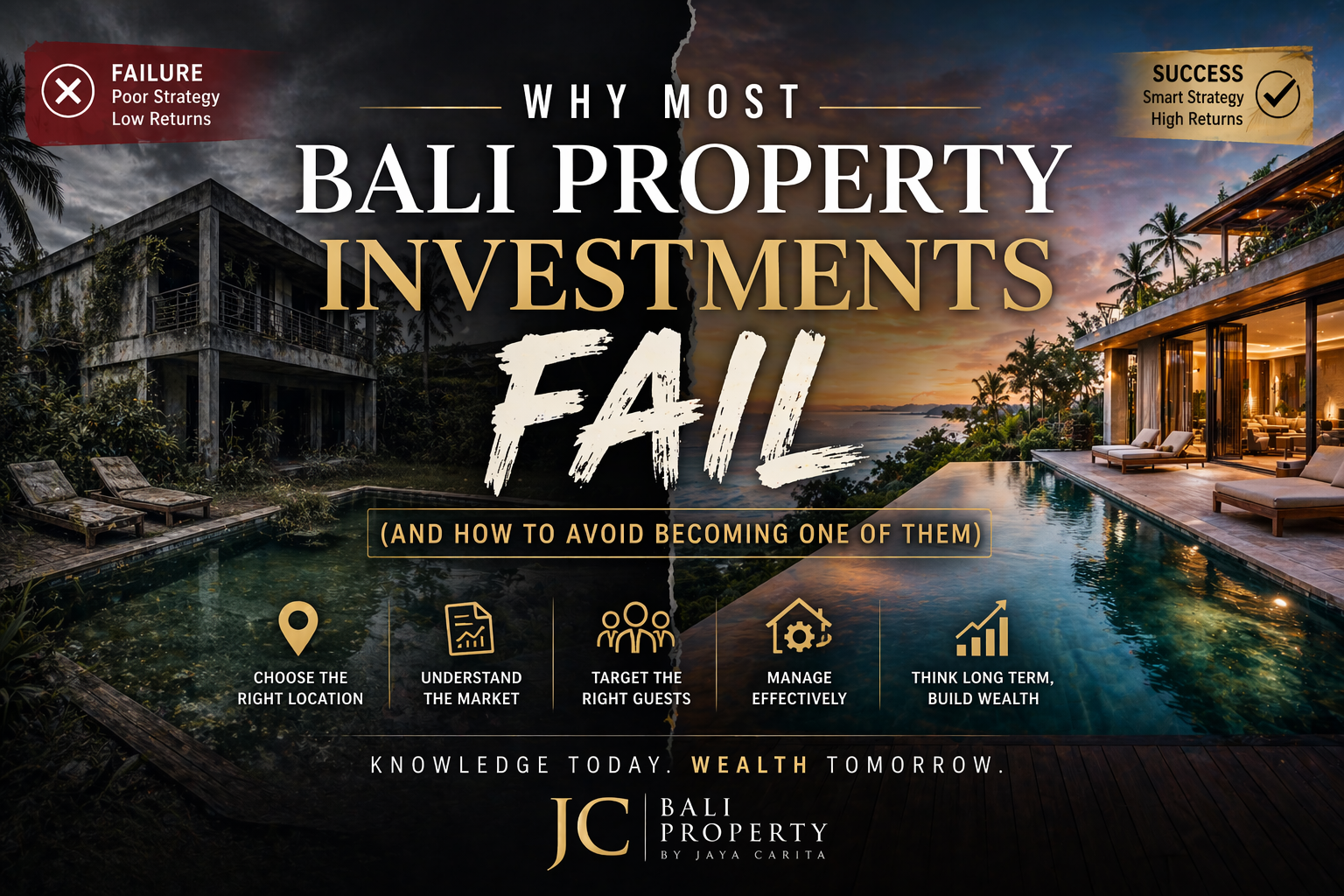
Why Most Bali Property Investments Fail (And How to Avoid Becoming One of Them)
Because the difference between profit and disappointment is not luck—it’s understanding.
Bali has become one of the most talked-about property markets in the world.
From social media to investment forums, the narrative is consistent:
Beautiful villas.
Strong rental demand.
Attractive returns.
At first glance, it looks like an obvious opportunity.
And in many ways, it is.
But there is a side of the story that is rarely discussed.
Not every investment in Bali succeeds.
In fact, many underperform.
Some struggle to reach expected occupancy.
Some generate lower-than-expected returns.
Some become difficult to manage over time.
And the question is:
Because the difference between a successful investment and an underperforming one is not random.
It is structural.
It is strategic.
And more often than not—it is avoidable.
The Myth of “Any Villa Will Work”
One of the most common misconceptions is this:
“If I own a villa in Bali, it will generate income.”
This assumption may have been partially true years ago.
When supply was limited and demand was growing rapidly.
But today, the market has evolved.
There are:
- More developers
- More listings
- More competition
Guests have more options than ever.
And when options increase, expectations rise.
Which leads to a new reality:
Not all villas perform equally.
Understanding Failure: It’s Not What You Think
When an investment underperforms, many people assume:
- The market is bad
- The timing was wrong
- The location is not good
While these factors can play a role…
They are rarely the core issue.
Most failures come from:
- Weak positioning
- Poor strategy
- Lack of understanding
In other words:
The problem is not the market.
It’s how the investment was approached.
Mistake #1: Buying Without a Clear Strategy
This is the most common and most critical mistake.
Many investors start with:
“I want to buy property in Bali.”
But they don’t define:
- Why
- For what purpose
- With what expectations
Without a strategy, every decision becomes reactive.
You might choose:
- The wrong location
- The wrong type of property
- The wrong pricing approach
Strategy should come first.
Always.
Mistake #2: Prioritizing Emotion Over Function
Bali is emotional.
The views, the design, the atmosphere—it’s easy to fall in love with a property.
And while emotional connection is natural…
It can also be misleading.
A villa that looks beautiful is not always a villa that performs well.
Important questions often get ignored:
- Is the layout practical?
- Does it fit market demand?
- Is it comfortable for guests?
Aesthetic appeal attracts attention.
But functionality drives performance.
Mistake #3: Ignoring Market Positioning
In a competitive market, positioning is everything.
Who is your target guest?
- Couples?
- Families?
- Digital nomads?
Each segment has different needs.
If your property tries to serve everyone, it often serves no one well.
Strong positioning creates clarity.
And clarity attracts bookings.
Mistake #4: Overestimating Rental Income
This is where expectations often break.
Many investors rely on:
- Optimistic projections
- Unrealistic ROI claims
- Best-case scenarios
But real performance depends on:
- Seasonality
- Competition
- Management quality
Overestimation leads to disappointment.
Realistic expectations lead to sustainable results.
Mistake #5: Underestimating Management
Owning a villa is not passive by default.
It requires:
- Guest communication
- Maintenance
- Pricing adjustments
- Operational coordination
Poor management leads to:
- Negative reviews
- Lower visibility
- Reduced bookings
Even a great property can underperform with weak management.
Mistake #6: Choosing Location Based on Trend Alone
Trendy areas attract attention.
But they also attract competition.
A popular area today may become:
- Oversaturated
- Overpriced
- Less profitable
On the other hand, emerging areas may offer:
- Better entry price
- Higher growth potential
Choosing location requires balance:
Not just popularity—but potential.
Mistake #7: Ignoring the Guest Experience
Guests don’t just book a villa.
They book an experience.
And experience is shaped by details:
- Comfort
- Cleanliness
- Service
- Atmosphere
Small issues can lead to:
- Lower reviews
- Reduced trust
- Fewer bookings
Consistency is key.
Mistake #8: Lack of Exit Strategy
Many investors focus only on buying.
Few think about:
Selling or repositioning.
Without an exit plan:
- You limit flexibility
- You reduce long-term potential
A good investment considers:
Both entry and exit.
The Reality: Success Is Designed, Not Accidental
High-performing villas are not lucky.
They are:
- Well-planned
- Well-positioned
- Well-managed
Every strong investment is the result of:
Intentional decisions.
What Successful Investors Do Differently
Instead of guessing, they:
1. Start With Clarity
They define:
- Goals
- Strategy
- Expectations
2. Focus on Fit
They choose properties that match:
- Market demand
- Target audience
3. Think Long-Term
They consider:
- Growth
- Sustainability
- Future value
4. Use Data, Not Assumptions
They validate:
- Pricing
- Demand
- Performance
5. Build the Right System
They ensure:
- Strong management
- Consistent operations
The Hidden Advantage: Learning Before Acting
One of the most powerful things an investor can do is:
Pause—not to delay.
But to understand.
Because knowledge reduces:
- Risk
- Uncertainty
- Mistakes
And increases:
- Confidence
- Clarity
- Results
The Market Is Not the Problem
It’s important to understand this:
Bali is still a strong market.
Demand exists.
Opportunities exist.
But they are no longer automatic.
They are selective.
Which means:
The market rewards preparation.
From Risk to Opportunity
Every risk in property can be managed.
With:
- The right information
- The right strategy
- The right support
And when risk is managed, opportunity becomes clearer.
The Bigger Picture
This is not just about avoiding failure.
It’s about:
- Building a performing asset
- Creating sustainable income
- Positioning yourself for growth
Final Thought
Most Bali property investments don’t fail because the opportunity isn’t there.
They fail because:
The approach is incomplete.
But with the right understanding—
That changes everything.
Looking to Invest Smarter?
If you want to:
- Avoid common mistakes
- Understand real market conditions
- Choose properties that actually perform
We can help you approach Bali property with clarity and strategy.