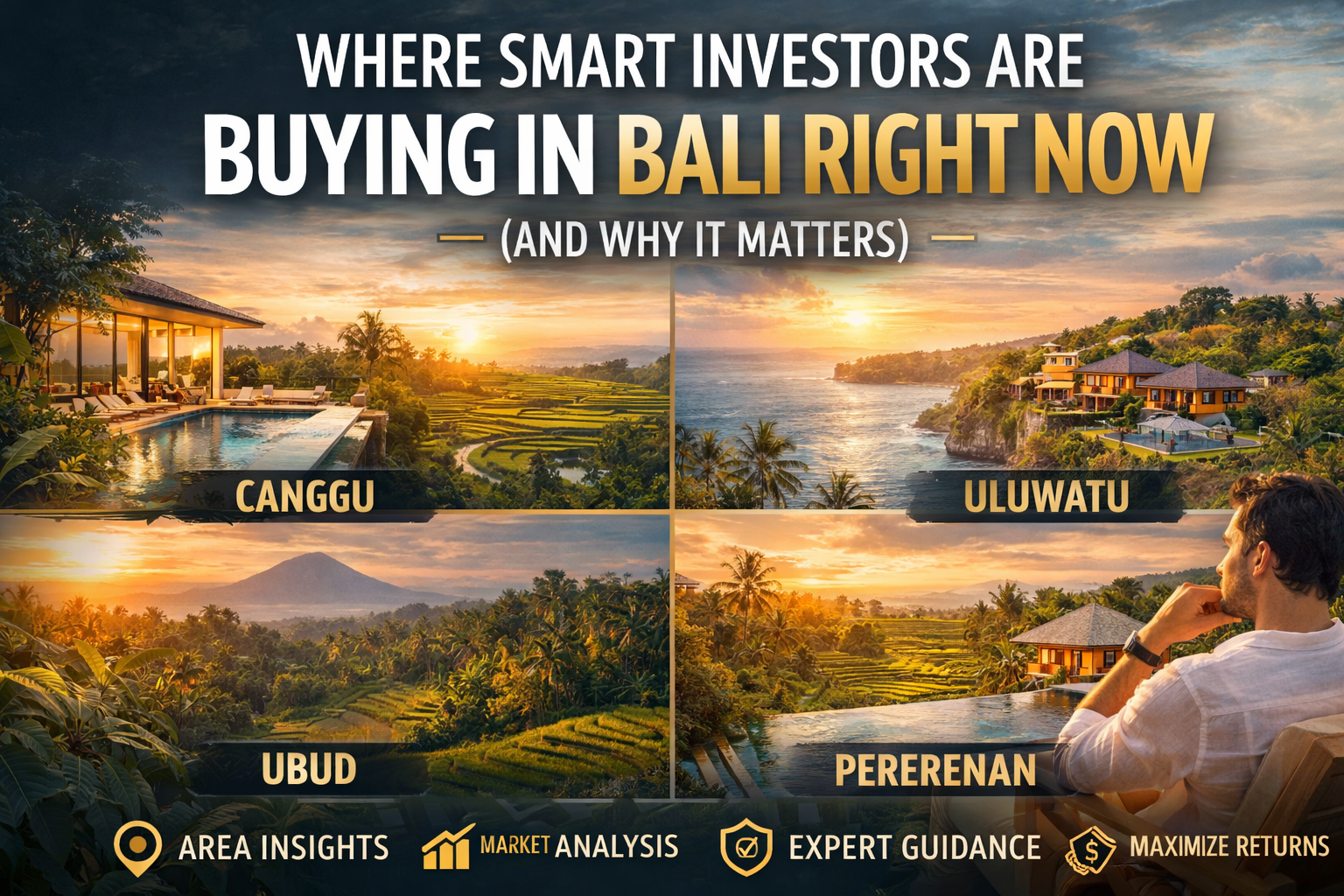
Where Smart Investors Are Buying in Bali Right Now (And Why It Matters More Than Ever)
For many people, Bali is seen as a single destination.
A place of beaches, villas, sunsets, and a relaxed lifestyle.
But for investors, Bali is something entirely different.
It is not one market.
It is a collection of micro-markets—each with its own rhythm, its own demand, and its own investment potential.
And this is where most people get it wrong.
They don’t lose money because Bali is a bad investment.
They lose money because they choose the wrong area for the wrong strategy.
Because in Bali, where you invest matters just as much as what you invest in.
Sometimes even more.
Understanding Bali as a Multi-Layered Market
Before diving into specific areas, it’s important to shift your mindset.
Bali is not like investing in a single city such as Singapore or Sydney, where pricing and demand follow relatively uniform patterns.
In Bali:
- Each area attracts a different type of tenant
- Each location has its own price dynamics
- Each zone offers different growth potential
You’re not just choosing a property.
You’re choosing a market within a market.
This is why two villas with similar prices can produce completely different results.
Because they’re not really in the same market.
Canggu: The Benchmark of Bali Investment
Canggu has become the benchmark.
It’s the reference point most investors use when they first enter the Bali market.
And for good reason.
Over the past decade, Canggu has transformed from a quiet coastal village into one of the most dynamic lifestyle hubs in Southeast Asia.
Today, it’s known for:
- High-end cafés and restaurants
- Co-working spaces
- Beach clubs and nightlife
- A strong international community
This combination creates something powerful:
Constant demand.
Both short-term and long-term.
Tourists, digital nomads, entrepreneurs, and remote workers all converge here.
From an investment perspective, this translates into:
- High occupancy rates
- Flexible rental strategies
- Strong resale appeal
But there’s a trade-off.
Canggu is no longer early-stage.
It is a mature market.
Which means:
- Entry prices are higher
- Competition is stronger
- Differentiation is essential
You can still perform well in Canggu.
But only if your property stands out.
Average properties no longer succeed here.
Pererenan: The Rise of a Premium Alternative
Just minutes away from Canggu lies Pererenan.
And while it used to be seen as an extension of Canggu, that perception is changing.
Pererenan is developing its own identity.
Quieter. Cleaner. More refined.
It attracts a slightly different audience:
- People who want proximity to Canggu
- But without the noise and density
- People willing to pay for a more exclusive environment
From an investment perspective, this is extremely interesting.
Because it represents a transition phase:
- No longer unknown
- But not yet fully saturated
This is often where the best opportunities exist.
Prices are rising—but still below peak levels.
Demand is growing—but not yet overcrowded.
For investors, this creates a balance:
- Strong current performance
- Future growth potential
Pererenan is not just “the next Canggu.”
It’s becoming a premium zone with its own positioning.
Uluwatu: Where Lifestyle Meets High-End Positioning
Uluwatu offers something that very few places can replicate.
Cliffside views.
Endless ocean horizons.
A sense of space and exclusivity.
This is not a mass-market location.
It is a lifestyle-driven luxury market.
The type of tenant here is different:
- Short-term luxury travelers
- Couples and honeymooners
- High-spending visitors
This shapes the investment strategy.
Uluwatu is particularly strong for:
- Short-term rentals
- Premium nightly pricing
- Unique architectural villas
But it’s not without its challenges.
Some areas have:
- Limited access
- Greater distance from central hubs
- Infrastructure still developing
This means:
Uluwatu requires more precision in property selection.
But when done right, it can deliver exceptional returns.
Seseh: Early-Stage Opportunity
Seseh is one of the most talked-about emerging areas.
But unlike hype-driven markets, Seseh’s growth is more organic.
It benefits from:
- Close proximity to Canggu
- Beach access
- Lower density
Right now, Seseh sits in an interesting position.
It is not fully developed.
But it is no longer unknown.
This creates a classic early-stage investment scenario:
- Lower entry prices
- Increasing attention
- Gradual development
However, early-stage markets require a different mindset.
They are not about immediate maximum returns.
They are about positioning for the future.
Investors entering Seseh today are not just buying property.
They are buying into potential.
Ubud: A Different Investment Philosophy
Ubud is often misunderstood by investors.
Because they try to compare it with beach areas.
But Ubud operates on a completely different dynamic.
It is not driven by nightlife or beach clubs.
It is driven by:
- Wellness
- Nature
- Culture
- Long-stay living
This creates a unique tenant profile:
- Retreat participants
- Wellness-focused travelers
- Long-term residents
The investment strategy here is also different.
Short-term rentals exist—but the real strength lies in:
- Monthly rentals
- Retreat-style properties
- Experience-driven stays
Ubud is less volatile.
Less trend-driven.
More stable in its own niche.
For the right investor, this can be extremely attractive.
Why Area Selection Impacts Your Returns
Choosing the wrong area doesn’t just reduce your income.
It limits your entire investment potential.
Here’s why:
1. Demand Type Changes Everything
Different areas attract different tenants.
And different tenants behave differently:
- Spending habits
- Length of stay
- Expectations
If your property doesn’t match the tenant profile, performance suffers.
2. Pricing Power Comes from Location
In Bali, pricing is not just about the villa.
It’s about where it is.
A well-located property can command premium pricing.
An average location struggles—even with a beautiful villa.
3. Exit Strategy Depends on Area Strength
When you decide to sell, buyers look at:
- Location
- Demand
- Market perception
Strong areas are easier to exit.
Weak areas take longer.
Micro-Location: The Detail Most People Ignore
Even after choosing the right area, there’s another layer:
Micro-location.
This is where small details create big differences.
Within the same area:
- One villa may be fully booked
- Another may struggle
Why?
Because of:
- Road access (wide vs narrow)
- Distance to main roads
- Nearby noise sources
- Surrounding developments
A 5-minute difference can impact occupancy significantly.
This is where experience matters.
Matching Area with Strategy
The biggest mistake investors make is choosing area first, strategy second.
It should be the opposite.
Start with your goal:
- Passive income
- High yield
- Long-term appreciation
Then match the area.
For example:
- Stable long-term → Pererenan, Ubud
- High short-term returns → Canggu, Uluwatu
- Growth potential → Seseh
There is no “best area.”
Only the right one for your objective.
The Future of Bali’s Investment Landscape
Bali is evolving.
New infrastructure is being developed.
New areas are gaining attention.
The map is not fixed.
Investors who succeed long-term are not those who follow trends.
But those who understand patterns.
They see:
- Where demand is moving
- Where development is happening
- Where pricing is still reasonable
And they act early.
The Psychology Behind Smart Investment Decisions
At its core, investing in Bali is not just about data.
It’s about decision-making.
Most people wait for certainty.
But in real estate, certainty often comes too late.
By the time an area is “safe,” it is usually:
- More expensive
- More competitive
- Less profitable
Smart investors don’t chase safety.
They look for calculated opportunity.
Risk vs Opportunity: Finding the Balance
Every area comes with trade-offs.
- Mature markets → Lower risk, lower upside
- Emerging markets → Higher risk, higher upside
The goal is not to eliminate risk.
But to balance it with opportunity.
This is where strategy becomes essential.
Final Thought
Bali is not a simple market.
But that’s exactly what makes it powerful.
Because complexity creates opportunity.
And opportunity rewards those who understand it.
Choosing the right area is not just a step in the process.
It is the foundation of your investment.
Looking for the Right Opportunity?
If you’re exploring investment in Bali and want clarity on:
- Which areas align with your goals
- Where demand is actually growing
- What type of villa performs best
We can help you navigate the market with a clear and structured approach.
Because in Bali:
The right location doesn’t just improve your investment.
It defines it.